Ground School
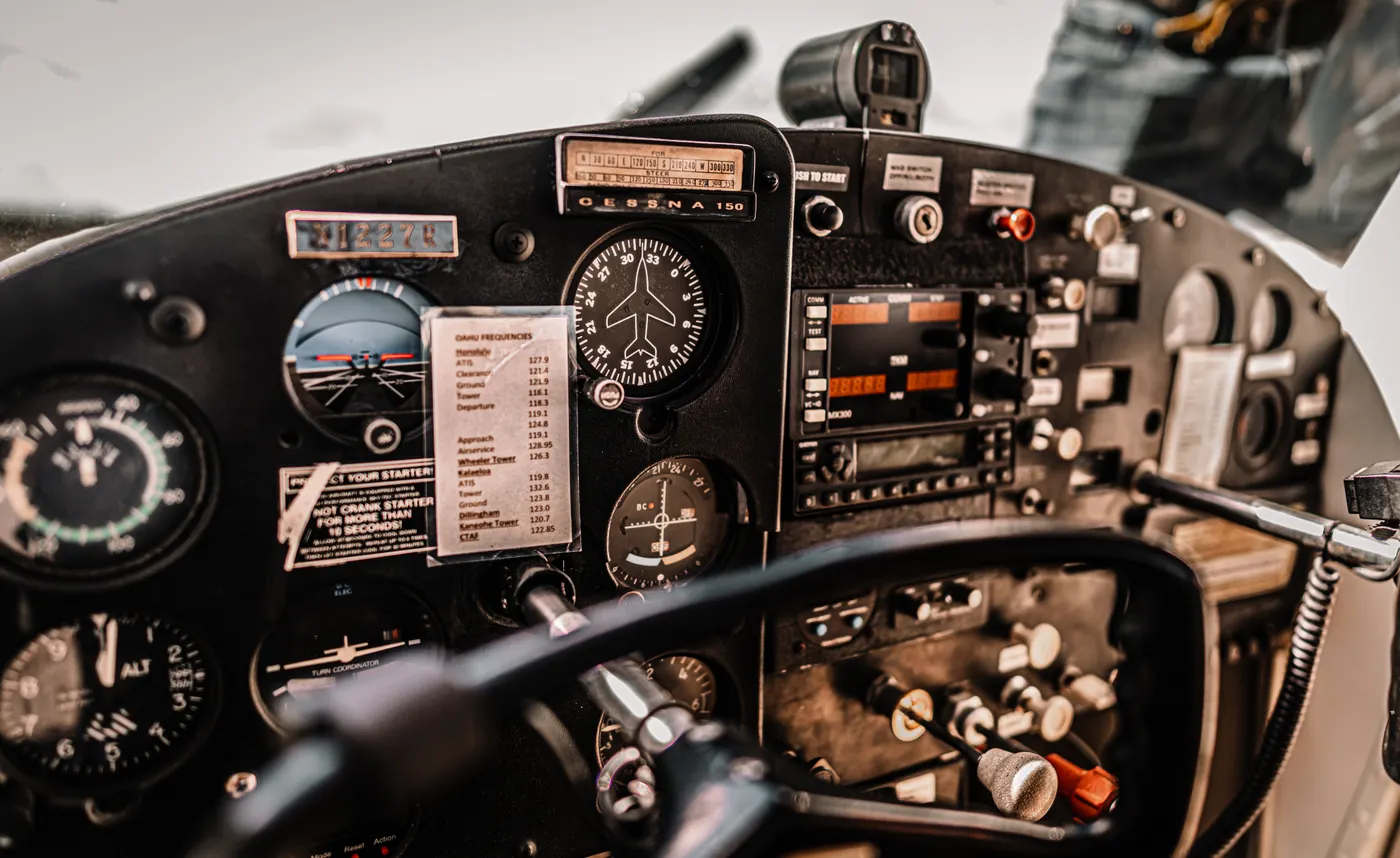
Walk into any general aviation cockpit and your eyes will land on a cluster of six round gauges arranged in two rows of three directly in front of the pilot. Pilots call this arrangement the "six pack." These instruments are the core of basic flight — they tell you how fast you are going, which way you are pointed, how high you are, and whether your aircraft is flying coordinated and in balance. Every aspiring pilot needs to understand all six before they ever sit in the left seat, because understanding them now means you can focus on actually flying the aircraft rather than deciphering the panel during your early lessons.
This guide covers each instrument in detail: what it measures, how it physically works, what the markings mean, and the common errors and limitations you need to know. We will also cover the two systems that power these instruments — the pitot-static system and the vacuum system — and explain why the magnetic compass, despite its simplicity, requires more careful interpretation than most beginners expect.
In a conventional six-pack layout, the instruments are arranged in two rows. Top row, left to right: the Airspeed Indicator, the Attitude Indicator, and the Altimeter. Bottom row, left to right: the Turn Coordinator, the Heading Indicator, and the Vertical Speed Indicator. This specific layout is intentional. The Attitude Indicator sits at the center top because it is the primary instrument during most phases of flight. The other five instruments are cross-checked against it constantly to build a complete picture of the aircraft's state.
The six instruments divide neatly into two groups based on the system that drives them. The pitot-static instruments — the Airspeed Indicator, Altimeter, and Vertical Speed Indicator — work by measuring air pressure from the pitot tube and static ports. The gyroscopic instruments — the Attitude Indicator, Heading Indicator, and Turn Coordinator — rely on spinning gyroscopes to sense orientation and movement. Understanding these two groups helps you understand what fails when something goes wrong, and why.
The Airspeed Indicator measures the speed of the aircraft through the air, expressed in knots in most of the world. It does not measure speed over the ground — that is a different value affected by wind. The ASI measures indicated airspeed, which is the raw reading straight off the instrument. It is the primary speed reference for all phases of flight: climb, cruise, approach, and landing.
The ASI is connected to two sources of air pressure. The pitot tube, mounted on the aircraft's nose or wing and pointed forward into the airflow, captures ram air pressure. This is called total pressure or pitot pressure — it is the combination of static (ambient) pressure plus the dynamic pressure created by the aircraft's forward motion. The static port, a small flush opening on the side of the fuselage, captures only the ambient atmospheric pressure with no ram effect.
Inside the ASI, a sealed expandable capsule called an aneroid capsule is connected to the pitot tube. The capsule sits inside a chamber connected to the static port. As the aircraft speeds up, pitot pressure increases relative to static pressure, the capsule expands, and a mechanical linkage drives the needle around the dial. When the aircraft slows, pitot pressure drops, the capsule contracts, and the needle moves back. The faster you fly, the greater the pressure differential, and the higher the airspeed reading.
The ASI face is colour-coded to communicate operating limits at a glance. Learning what each colour means is a required knowledge item for any pilot.
Some aircraft also show a blue line on the ASI: this is Vyse, best single-engine rate of climb speed, applicable to twin-engine aircraft. For single-engine aircraft, no blue line appears.
Dedicated lessons on every instrument in the panel. One payment, lifetime access.
The Attitude Indicator, also called the Artificial Horizon, is the most important instrument in the panel during instrument flight. It shows the aircraft's pitch attitude (nose up or nose down relative to the horizon) and bank angle (how much the wings are tilted left or right). A miniature aircraft symbol is fixed to the instrument face, and a blue-and-brown horizon bar moves behind it to represent the actual horizon. When the aircraft pitches nose up, the horizon bar drops below the miniature aircraft; when the aircraft banks left, the horizon bar tilts right relative to the miniature wings.
The Attitude Indicator is a gyroscopic instrument. Inside it, a spinning gyroscope maintains its orientation in space due to gyroscopic rigidity — the property that causes a rapidly spinning mass to resist any change in the orientation of its spin axis. As the aircraft pitches and banks around it, the gyroscope stays aligned with the true horizon, allowing the instrument to display the aircraft's attitude relative to that reference.
In most piston general aviation aircraft, the Attitude Indicator's gyroscope is spun by engine-driven vacuum. The engine drives a vacuum pump that creates suction through a system of lines, and air drawn through the instrument spins a small rotor at thousands of RPM. The vacuum gauge in the cockpit shows the system pressure; most aircraft require approximately 4.5 to 5.5 inches of mercury to operate the gyroscopic instruments correctly. If vacuum pressure drops below limits, the AI will slowly become unreliable and eventually topple or precess off the true horizon.
Gyroscopes are not perfectly rigid in practice. Over time, bearing friction and other forces cause precession, a gradual drift of the gyroscope away from its true aligned position. To counteract this, the Attitude Indicator has an internal erection mechanism, usually using pendulous vanes, that continuously nudges the gyroscope back toward vertical alignment with gravity. This erection system works slowly and correctly during straight-and-level flight, but it can be confused during prolonged turns and accelerations, which is one reason the AI can show slightly incorrect attitude readings during sustained manoeuvres.
The Altimeter measures the aircraft's altitude above a reference pressure level. It is a pressure-measuring device: as the aircraft climbs, atmospheric pressure decreases, and the altimeter converts this pressure change into a displayed altitude reading in feet (or metres in some countries). The altimeter does not directly measure distance from the ground — it measures the difference in air pressure between the aircraft's current position and a set reference.
Inside the altimeter are a stack of sealed, hollow metallic capsules called aneroid wafers. These capsules are partially evacuated and respond to changes in static pressure from the aircraft's static port. As static pressure decreases with altitude gain, the wafers expand. As pressure increases during descent, the wafers compress. This expansion and contraction is mechanically linked to the altimeter's needle and drum to produce the displayed altitude.
The Kollsman window (also called the subscale or QNH setting window) is a small window on the altimeter face, usually located at the 3 o'clock position, showing the reference pressure setting in either inches of mercury (in the US and some other countries) or hectopascals (in most ICAO countries). By turning a knob on the instrument, the pilot adjusts this reference pressure. When the local QNH (the mean sea level pressure at a nearby reporting station) is set in the Kollsman window, the altimeter reads altitude above mean sea level (MSL).
Indicated altitude is what the altimeter displays when QNH is set. Pressure altitude is what the altimeter displays when the standard pressure setting of 29.92 inHg (1013.25 hPa) is set. Pressure altitude is used for flight level operations and for performance calculations at high altitude. These two values differ whenever the local QNH is not exactly 29.92 inHg, which is almost always.
The altimeter has several sources of error. Position error arises from imperfect static port placement — the static port may sense slightly different pressure than the true free-stream static pressure depending on the aircraft's angle of attack and speed. Instrument error is caused by small manufacturing tolerances. Temperature error is the most operationally significant: the altimeter is calibrated to the International Standard Atmosphere (ISA), which assumes a standard temperature lapse rate. In colder-than-standard air, the atmosphere is denser and compressed — the aircraft is actually lower than the altimeter indicates. The phrase "high to low, look out below" is a useful reminder: flying from a high-pressure area to a low-pressure area (or into cold air) puts you lower than indicated.
The Vertical Speed Indicator shows the rate at which the aircraft is climbing or descending, expressed in feet per minute (fpm). The centre of the dial is zero. Upward needle deflection indicates a climb; downward deflection indicates a descent. A typical training aircraft in a normal climb might show 500 to 700 fpm; a typical descent on approach might show 500 to 600 fpm.
The VSI is also connected to the static port. Inside the instrument, a chamber is connected to the static port through a calibrated, restricted orifice called a capillary or metered leak. When the aircraft's altitude is constant, the pressure inside the chamber and the pressure outside the restriction are equal, and the needle reads zero. When the aircraft climbs, static pressure decreases. The chamber pressure changes rapidly through the direct static port connection, while the pressure on the other side of the restriction changes slowly. This pressure differential moves a diaphragm, which drives the needle upward to show a climb rate.
Because of this design — specifically the restricted orifice that deliberately slows pressure equalization — the VSI has an inherent lag of approximately 6 to 9 seconds. When a pilot initiates a climb, the VSI needle does not immediately show the correct climb rate; it takes several seconds to catch up. Similarly, when levelling off, the VSI will continue to show a climb for several seconds after the aircraft has actually stopped climbing. This lag makes the VSI unsuitable for precise instrument flight as a primary pitch reference. Pilots use the Attitude Indicator and Altimeter for primary pitch control, and treat the VSI as a trend instrument for confirming that established climbs and descents are stable.
Some modern aircraft are equipped with an Instantaneous Vertical Speed Indicator (IVSI), which adds accelerometer-driven dashpots to reduce the lag significantly. Conventional VSIs, however, remain the standard in most piston training aircraft.
The Heading Indicator, also called the Directional Gyro (DG), displays the aircraft's magnetic heading on a rotating compass card. The pilot reads the heading off a fixed index at the top of the instrument. Unlike the magnetic compass, the Heading Indicator is gyroscopically stabilised, which means it does not swing and oscillate during turns and manoeuvres. This makes it the primary heading reference during flight, while the magnetic compass serves as the backup and calibration reference.
The Heading Indicator's internal gyroscope spins in a near-horizontal plane and uses gyroscopic rigidity to maintain its orientation in space. The compass card is mechanically attached to the gyroscope, so as the aircraft turns, the card rotates relative to the fixed index, displaying the changing heading. Like the Attitude Indicator, the DG is typically powered by the engine-driven vacuum system.
The Heading Indicator has no magnetic reference of its own. It must be aligned with the magnetic compass before flight and periodically re-aligned during flight. At the start of every flight, after the gyroscope has had time to spin up and stabilise (typically a minute or two after engine start), the pilot sets the DG to match the magnetic compass reading while the aircraft is stationary and straight. During flight, the DG is re-aligned approximately every 15 minutes, again using the magnetic compass as the reference while in straight-and-level, unaccelerated flight.
Bearing friction and mechanical imperfections cause the DG's gyroscope to precess gradually over time. This means the heading displayed will slowly drift away from the true magnetic heading, typically by 3 to 5 degrees per 15 minutes in a well-maintained instrument. If the DG is not periodically realigned, it can be showing a heading that is significantly different from the actual aircraft heading. This is why the 15-minute realignment interval is a standard operating habit.
The Turn Coordinator is the most information-dense of the six instruments: it provides two separate, equally important pieces of information from a single gauge. The upper part of the instrument shows a miniature aircraft symbol that banks in the direction of the turn. The lower part contains a ball in a curved glass tube filled with liquid, called the inclinometer or slip-skid ball.
The miniature aircraft in the Turn Coordinator indicates the rate of turn, not bank angle. When the miniature aircraft's wing aligns with the index mark (usually labelled "L" or "R" on either side), the aircraft is in a standard rate turn of 3 degrees per second. A complete 360-degree turn at standard rate takes exactly 2 minutes, which is why standard rate is sometimes called a "2-minute turn." Maintaining standard rate turns is important during instrument flying, as ATC procedures are often based on standard rate turn timing.
The gyroscope inside the Turn Coordinator is mounted at a slight angle (approximately 30 degrees from vertical), which allows it to sense both roll rate and yaw rate simultaneously. This is different from the older Turn-and-Slip Indicator, whose gyroscope was mounted vertically and sensed only yaw rate.
The slip-skid ball at the bottom of the Turn Coordinator is the simplest instrument in the cockpit but one of the most important. It measures whether the aircraft is in coordinated flight: whether the lift, thrust, gravity, and centrifugal forces acting on the aircraft are balanced laterally.
The memory phrase for correcting the ball is "step on the ball": apply rudder pressure toward whichever side the ball has moved to, and it will return to centre. Uncoordinated flight is inefficient aerodynamically, increases drag, and, at slow airspeeds, can lead to an accelerated stall or spin entry. Keeping the ball centred is a foundational flying skill.

The Airspeed Indicator, Altimeter, and Vertical Speed Indicator are all connected to the aircraft's pitot-static system. This system has two types of input: pitot pressure and static pressure.
The pitot tube is an open-ended tube pointed forward into the oncoming air. It captures the total pressure of the airflow: static atmospheric pressure plus the dynamic pressure created by the aircraft's forward motion. Only the Airspeed Indicator uses pitot pressure. The static port is a flush port on the side of the fuselage, positioned to measure only undisturbed atmospheric pressure with no ram component. All three pitot-static instruments use static pressure. The Altimeter and VSI use only static pressure; the ASI uses both pitot and static together (the difference between them is the dynamic pressure that drives the airspeed reading).
The pitot tube is exposed to the outside air and is vulnerable to icing. In moisture-laden air at temperatures near or below freezing, ice can form over the opening of the pitot tube, blocking it completely. When the pitot tube is blocked, pitot pressure is trapped. A blocked pitot tube causes the ASI to behave strangely: during a climb, the trapped pitot pressure becomes relatively higher than the increasing static pressure, causing the ASI to read higher speed than actual; during descent, the reverse occurs.
To prevent pitot icing, aircraft are equipped with a pitot heater, an electric heating element built into the pitot tube. Best practice is to switch pitot heat on before entering visible moisture or conditions conducive to icing. Forgetting to use pitot heat when needed has contributed to serious accidents, including loss of airspeed awareness during critical phases of flight.
If the static port becomes blocked (by ice, a wasp nest, or a maintenance error), all three pitot-static instruments are affected. Most aircraft have an alternate static source inside the cockpit that the pilot can switch to, using slightly different cabin pressure as the static reference. When using the alternate static source, expect small errors in all three instruments due to the pressure difference between cabin and external air.
The Attitude Indicator and Heading Indicator both rely on spinning gyroscopes. In most piston training aircraft, these gyroscopes are driven by the engine-driven vacuum system. The engine powers a vacuum pump that creates suction, drawing air through each gyroscopic instrument. As air flows through, it impinges on a small rotor inside the instrument and spins it to the thousands of RPM needed for gyroscopic rigidity.
The cockpit vacuum gauge shows the suction level in inches of mercury. Most aircraft require approximately 4.5 to 5.5 inHg for correct gyroscope operation. If the vacuum pump fails in flight, both the AI and HI begin to slowly run down. The AI will start to show erroneous pitch and bank indications, potentially misleading the pilot significantly. The HI will also drift from true heading as its gyroscope slows.
This is why the Turn Coordinator, which runs on electrical power rather than vacuum, is intentionally connected to a separate power source. If the vacuum system fails and both the AI and HI become unreliable, the pilot can still use the electrically-powered Turn Coordinator for bank information, the altimeter for pitch trend, and the airspeed indicator for energy state, to maintain control while navigating to a safe landing. This distinction between electrically-powered and vacuum-powered instruments is an important piece of knowledge for any pilot flying in marginal conditions.
Every aircraft carries a magnetic compass, a simple instrument that uses a magnetised card floating in compass fluid to align with the earth's magnetic field. It requires no electrical power and no vacuum, which is why it is the ultimate backup for heading information. However, the magnetic compass is also the trickiest instrument to interpret correctly, and beginning pilots are often caught off guard by its errors.
Variation (also called declination) is the angular difference between true north and magnetic north at any given location on Earth. Magnetic north is not at the geographic North Pole — it is a point in northern Canada that also moves slowly over years. The variation changes with location: in western parts of North America it can be over 15 degrees east, while in eastern areas it may be several degrees west. Aeronautical charts show variation lines (isogonic lines) so pilots can convert between true and magnetic headings. The rule: "East is least, West is best" — easterly variation is subtracted from true heading to get magnetic heading; westerly variation is added.
Deviation is the error caused by the aircraft's own magnetic fields, from the engine, avionics, and metal structure, that deflect the compass from true magnetic north. Each aircraft has a deviation card mounted near the compass, showing the compass heading to steer for each magnetic heading. Deviation is typically small (1 to 5 degrees) in well-maintained aircraft, but it varies with heading.
The magnetic compass has well-known dynamic errors during turns and accelerations. These errors occur because the compass card is weighted to remain horizontal but, when the aircraft banks or accelerates, inertia and the dip of the earth's magnetic field lines interact with the compass in predictable ways.
The two most important error groups are remembered with the mnemonics ANDS and OSCDV:
Because of all these errors — variation, deviation, and turning and acceleration errors — the magnetic compass is not used as the primary heading reference during flight. The Heading Indicator, which is free of these dynamic errors, provides a stable heading reference. The compass's role is to provide the magnetic reference for periodically aligning the DG. This is why you always check the DG against the compass before takeoff, and why you make that check again approximately every 15 minutes during flight.
When you arrive at your first flight lesson knowing what each instrument does and why, something important happens: the aircraft becomes a classroom you can actually absorb, rather than an overwhelming environment where you are simultaneously learning to fly and trying to decode a panel of unfamiliar gauges.
Instructors who have taught hundreds of students consistently report that the students who walk in with solid ground school knowledge progress faster, ask sharper questions, and reach solo in fewer hours. The reason is straightforward: cognitive load. The cockpit demands your attention on many things at once — control inputs, traffic awareness, radio communication, checklist discipline, and spatial orientation. Every concept you have already understood and stored in long-term memory is one fewer thing you need to actively process in the moment.
Understanding the six-pack before your first lesson means you already know why the ASI needle drops during a slow turn, why the altimeter needs to be set at each new airport, why the DG drifts and needs to be checked, and why the ball matters. Your instructor can focus on teaching you to fly, not on explaining what the altimeter is. That efficiency compounds over time: faster solo, fewer hours to certificate, and a deeper understanding that shows up at the practical test and beyond.
The six instruments are not just panel gauges. They are the language the aircraft uses to communicate its state to you. Learning to read that language before you get in the aircraft is one of the most efficient investments a student pilot can make.
SkyPrep includes dedicated lessons on all six: airspeed indicator, altimeter, attitude indicator, heading indicator, turn coordinator, and vertical speed indicator. Each explained clearly — how it works, what it tells you, and why it matters in the cockpit. $79 one-time, lifetime access.
Start Ground School for $79 Read Lesson 1 free first